Gob is Goob
Finding God in the Nonsensical.

An old friend of mine owns a piece of outsider art I have always coveted. The hand-painted sign reads GOB is GOOB. The moment I saw it, I thought yes, that will do. As a claim, it suffices. The artist had taken time to decorate this piece of goob news, then set it along the highway to spread the word.
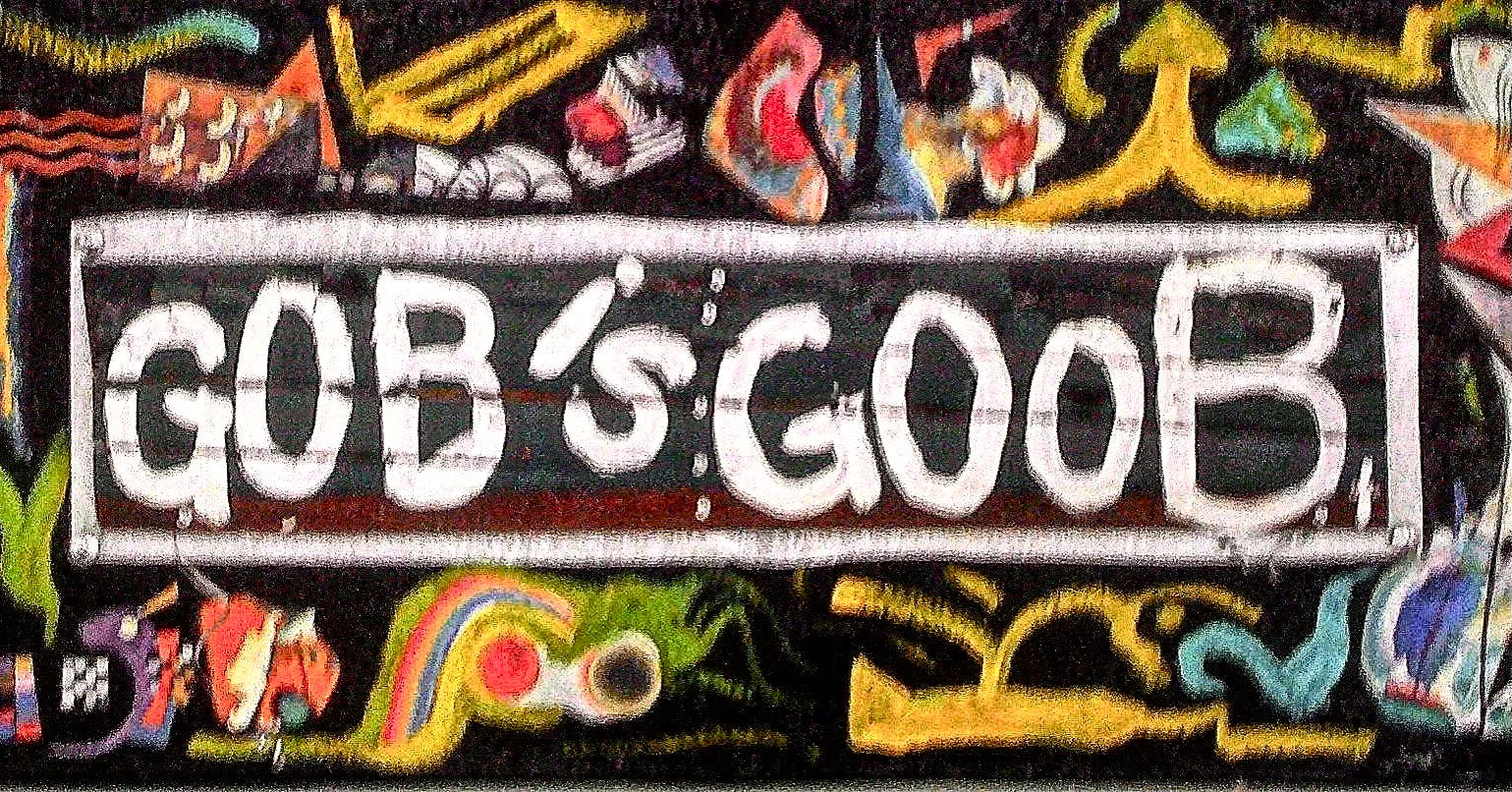
For me, those two bold B’s provided that little hiccup of comprehension, that moment of decoding that celebrates both ambiguity and resolution. Most of all, it made me smile. Humor matters a lot to me. I would balk at a too-serious heaven.
In her poem Our Bog is Dood (1950) Stevie Smith used the lisping mispronunciation of children to address the dark side of fundamentalism. I’ll put Gob is Goob to brighter use.
It’s a challenge that faith belongs to the right, imaginative side of the brain, and religion to the dogmatic left. Kierkergaard’s leap of faith has nothing to do with proof. We need traditions, rituals and prayers as a short cut to speaking to God—it would be exhausting to conjure Him up metaphysically every time we sought spiritual bread—but those same religious practices become the tribal certainties that have nothing to do with, in fact obstruct, Kierkergaard’s leap.
That said, this attempt to explain my wooly belief system to myself and my son Finn is itself a left-brained attempt to nail down what cannot—what perhaps should not— be analyzed.
I was watching a documentary some years ago. The existence of God was being discussed. I looked down at my TV tray: the pool of light across it, my wine glass, a chocolate wrapper. Hardly a beautiful sight, but somehow miraculous at that moment—not the objects, not the light, just the act of recognition. “Of course there’s a God,” I said aloud. I really meant it. In vino veritas. But what did I mean by God? My particular God? I want to try and set it down in writing.
Perhaps I should start with what do I not believe in. An infinite and unknowable deity explained by, tied to, a single religion or church? Preposterous. An intervening benevolence? Disproved daily, hourly across the world. A God keeping count of our every action down here, deciding our place posthumously? A God remotely bounded by our estimates at time and space?
When I looked at that TV tray, the God I felt sure existed was made up, like good poetry, by nailed down facts and abstract jolts of recognition. An entity secured by the objects, actions and feelings we encounter in life but more proven, at least to me, by those instances that seem to make no evolutionary sense: an atheist giving up their life for a stranger; a man imagining gravity; Mozart.
Not long ago, two humpback whales were documented saving a seal from a pod of orcas. Why? Meanwhile, somewhere deep below, a male pufferfish decorates the seabed with painstaking ‘galleries’ for a passing female to inspect. Who made him an artist, and she a critic? These questions feed my faith.
I mention the whales and the pufferfish because I think an animistic view of the world holds wonders of connection that more recent religions have forgotten. Can a convincing deity be made from any faith insistent upon a God with a particular, even obsessive, focus upon man? That seems left-brained hubris on our part. The Jesuit poet Gerard Manley Hopkins wrote of God’s grandeur gathering to a greatness like the ooze of oil crushed. God surely leaks through all creation?
Finding God in Painting
I also brought up the pufferfish because he connects to our outsider artist who made that road sign. I’m an artist myself and have always been very curious about the Art World’s appropriation of the visionary. Outsider art is held high in the Art World, and in many ways, Van Gogh became art history’s patron saint because he is a crossover. That difficult Dutchman was the holy outsider, the martyr crucified by a blind public and a dismissive elite.
But overall, I’ve come to feel that the practice and business of fine art is a very left-brained, very literal, non-spiritual creature indeed. Craft and theory rate far above mystery. The Impressionists were all about scientific discoveries in light and color, their new pigments newly tubed, and every Ism that has followed since has been a theoretical discourse upon the language of art. Cezanne’s flat depth is certainly a miracle of art’s language, but it says nothing about the light or the feel of Provence. Rothko’s work needs to be hung in rooms called chapels to let the public know it is about God.
Symbolism and Surrealism made forays back towards the Romantic, but the true visionary has always been an uncomfortable anomaly in the Art World, despite its efforts to embrace them—they talk too much about God. Twenty-five years ago, in Gadsden, Alabama, I had a show alongside Howard Finster. That famous folk artist’s fundamentalist, Commie-hating speech at dinner afterwards would have no place at the Whitney. (I’ve always liked that about British Art: we are quite open to nutters. From William Blake to Stanley Spencer, from Richard Dadd to Samuel Palmer, we seem to have time for the zealot.)
Like many artists, I began my life in art as a vocation. I didn’t intend to be a hermit but I did want to find a small band of fellow outsiders. On our journey we meet financial reality and the demands of the marketplace, and what began as a quest can start to feel like a day job. We can burn out. This Spring I needed a jump start.
I’m a lapsed catholic but a huge fan of our current pope (the thoughtful counterbalance to that other American). Like all my friends, I’ve been anxious about Artificial Intelligence— about the jobs that will vanish and the social disruption to follow, but even more about the moral state of the future beyond that. So Pope Leo’s recent encyclical: Magnifica Humanitas: On Safeguarding the Human Person in the time of Artificial Intelligencespoke to me.
It also gave me sudden direction in my own art. I remembered a detail from my childhood. I was educated by the Jesuits. At my boarding school every piece of work we did; essays, translations, math problems, would be dedicated to God. At the top of the page, we would write A.M.D.G. ( Ad maiorem dei Gloriam For the greater glory of God, the motto of the Society of Jesus). Below, to conclude, we would write L.D.S. (Laus Deo semper Praise to God always).
What if I thought about my next painting this way? As both a declaration against AI but also a dedication? In my case, a dedication more to the ineffable? Pope Leo described God as dwelling in the human heart (and I embrace those qualities in us that he sees threatened by technology) but I wanted to keep my idea of God far less fixed, less human-centric, to keep God as unclassified as say, goob. What was interesting, however—and this is that constant balance between the tangible and the intangible, between the left and right sides of the brain—is that the sharp memory of that ritual, of writing A.M.D.G and L.D.S, was critical to a nebulous inspiration.
Ways of Communion
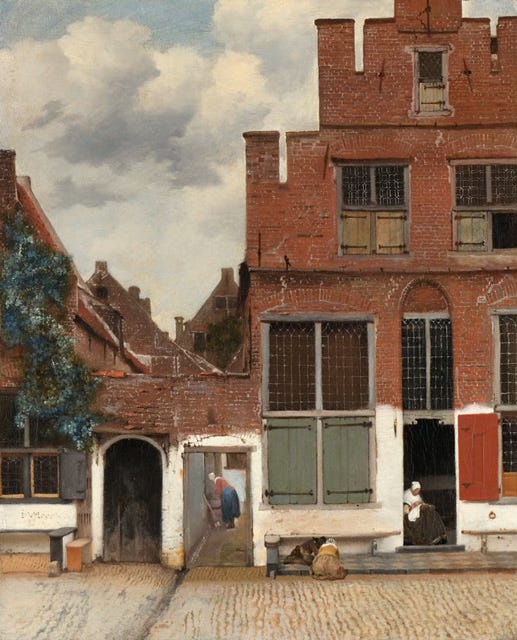
1. I picked a familiar subject to paint outdoors— a meadow not far from my studio. In our heyday of conceptual art, painting from life may seem very dusty and old-fashioned, but consider the conceptual miracle behind painting. In 1657 Vermeer began to paint ‘The Little Street (Het Straatje). His eye receives a view and he uses a few pigments, some brushes and a piece of canvas to record what he sees. Centuries later, our eyes look at the picture, comprehend Vermeer’s language and travel back through time to a 17th c. street in Delft—its vanished masonry, its human activity, its passing clouds. It is a miracle of communion.
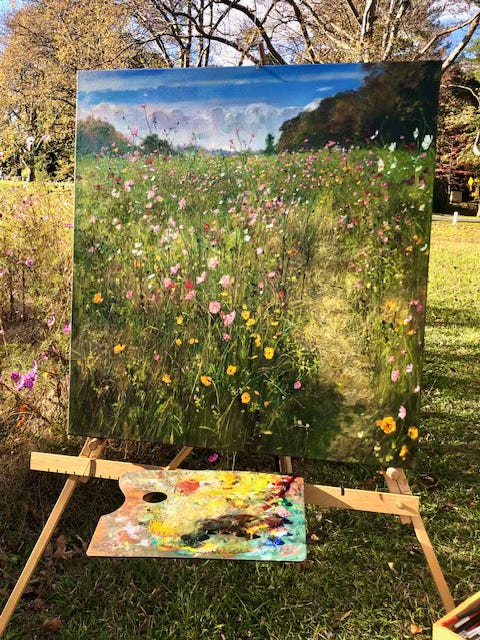
2. While I am painting, people wander up and talk about the beauty of the flowering meadow. They also kindly say my painting is beautiful. The meadow is full of activity, but the birds and insects, even the flowers, are all engaged in busy, ruthless survival, quite unaware that in our eyes they amount to beauty. Our communion with beauty is a strange indulgence in what is supposedly a Darwinian world.
3. The meadow is annually sown with flowers. Our care for the world is a strange thing. Where does our science and stewardship come from? The Jane Goodalls, the Richard Attenboroughs of the world? Activists have risked death and been killed for trying to protect forests.
Writing this very morning, I heard a bleat and then a crash outside my house. I rushed outside. A fawn had somehow injured itself in my neighbor’s yard. It could not get up, and its mother was dashing herself against the fence to rescue it. I tried to help, but the deer only grew more frantic. All I could do was open gates and gently guide her to the fawn. The neighbor and I called animal rescue. The whole thing was awful. At moments like that, I lean towards another lesson from the Jesuits: that this world is a vale of tears. There are times I’ve felt a gnostic disdain for a world full of such pain, even a readiness to leave it behind, but there wasn’t just that deer’s anguish, there was also our care, and even an organization ready to rescue a wild animal. Our care for the world is a strange, wonderful thing.
4. I don’t mind chatting to the passersby when I paint. Not at all. That’s being human and not wanting to have my communication dictated by Meta and its algorithms. A heavily-muscled jogger asked if he could take a closer look. His name was Keith. He was a Lyft driver and loved to draw when he could. We talked about art and what he liked to draw, and what I liked to paint, and why. Then he suggested I take my shoes and socks off to let the energy from the crystal motherlode beneath us flow up through my feet all the way to my brush. “You’ll see,” he assured me. “It will feel great.”
“I think I will,” I said, and did what he suggested. It did feel great, but later I caught sight of my blue-white feet and my sixty-year-old toenails, and they did not look great. Succumbing to vanity, and apologizing to a distant, vanishing Keith, I cut off my subterranean energy source. Keith had done his best to spread good news and so was I in painting that meadow. In our conversation we shared a happy, human connection. We were putting our sign out by the highway.
So, what am I passing on to Finn, and clarifying for myself? God by definition cannot be comprehended. That said, there are tangible realities of communion, in front of our eyes every day, realities that seem to make no scientific sense, that provide signposts towards Him. We need such wondrous facts to enter into wonder. If this is a vale of tears it is yet threaded through with empathy, spun with communion and loving actions that according to science are a waste of our time, fail to feed us, even injure us. Yet we feel and act, nonetheless. This is goob news.
I’ll close with another British poet. W.H. Auden, a year from dying, comforted a young Jay Parini, newly arrived in Oxford and suffering a panic attack. Auden poured Parini a huge vodka and told him the two consolations he had learned in life. “Rest in God,” he said, “and there is no such thing as time.” Auden knew how to keep faith simple, and complicated.
Postscript
I heard yesterday that the animal rescue people could not get to the injured fawn. The mother was too protective. She did get the fawn up into the wooded part of my yard. This morning she was standing vigil on the lawn. She let me at least put a large bowl of water near her. We looked at each other.
.
.
I appreciate your thoughts but, as ever in such matters, get hung up on the word “god” since it has been so abused by religions. It’s hard to pry it loose from past usage. I’m more inclined to pass that by and follow Kurt Vonnegut’s lead. “If this isn’t nice, what is?"
I suppose I identify most as agnostic, but I thoroughly enjoyed this piece. So personal and yet far-reaching. Thanks for the goob news!