Reunion
A Civil War Monument for Today

(This is the first in a series of short essays detailing the histories and folklore behind my art. A current exhibit of my work includes QR codes allowing viewers to listen to the same. “Your work is different,” the gallery owner explained, “people need to hear these stories.”)
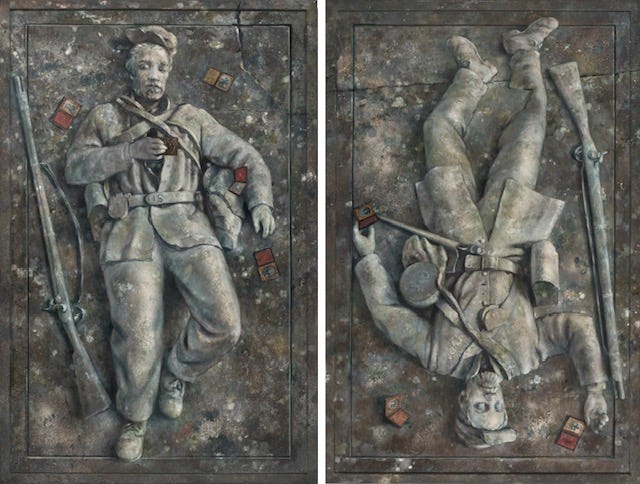
A fellow alumnus of my art school is a well-known British art critic. On Facebook he also provides a fervent voice on political matters. When I suggested to him that artists should perhaps be above politics, his reply was snippy. My defense was that the Homeric view might be best. Homer did not take sides. His subject was the tragedy of war. Trojan or Greek, he had no favorites. All men were victims, and prone to folly.
David, Delacroix and many other great masters (and masterpieces) aside, I think art still does best when it rises above partiality and deals with the timeless. Neither the somber Fail Safe nor its parodied satire Doctor Strangelove contain an atom of propaganda.
After decades as a realist painter documenting the American South, I made a choice: I turned my back on Courbet’s vehement advice that an artist should stick to painting his own time. In my narrative work, I instead chose to represent the past, particularly those odd details of history that are joltingly modern; forgotten facts that bristle with urgency, stories that startle yet simultaneously connect us to our ancestors and our place in the altered land.
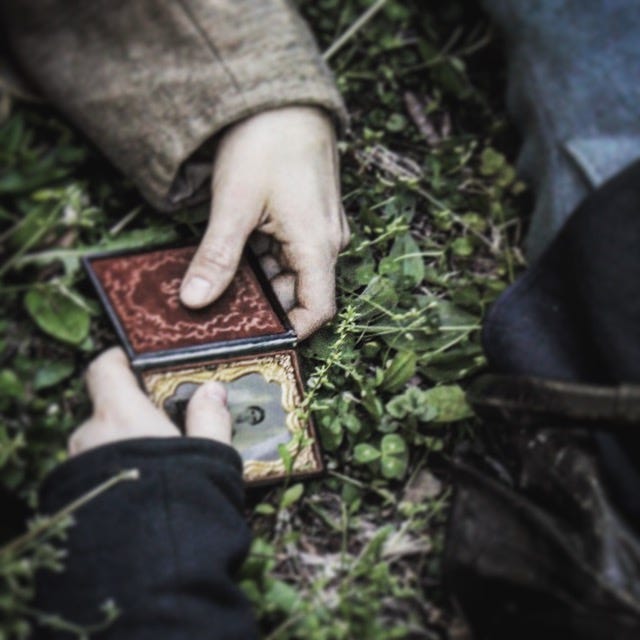
On a trip back to England, I was reading Drew Gilipin Faust’s marvelous book ‘This Republic of Suffering: Death in the American Civil War’. It contained one of those compelling details. During the war, both Union and Confederate soldiers carried ambrotype and tintype photos of their loved ones in the hopes that, should they receive a fatal wound on the battlefield, they might have time to recreate around them what the Victorians called ‘the good death’; a death at home, in one’s own bed, surrounded by family. Today a dying Ukranian, or a dying Russian, might reach for their phone for similar consolation.
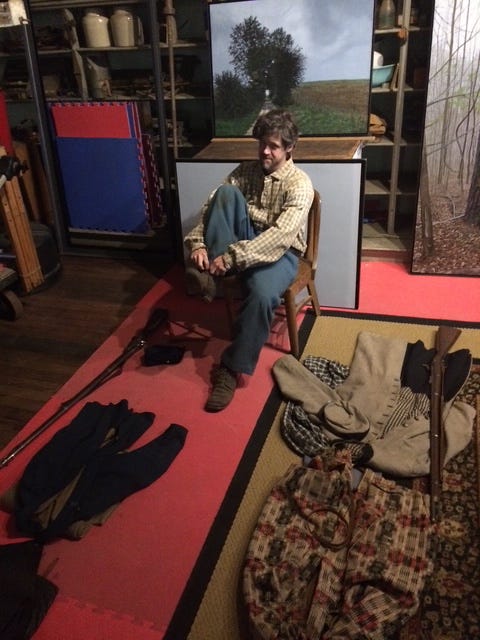
John Cleaveland, an artist friend, and once avid Civil War reenactor, had just generously bartered his veritable armory of uniforms, rifles, bayonets, even hobnailed boots for a painting of mine. I had the costumes to take on this untouched subject as a painting. But how?
On that same trip to England I revisited Bristol’s Lord Mayor’s Chapel. There I stumbled upon a medieval cadaver tomb. These monuments, or transi, enjoyed popularity through the Late Middle Ages (one imagines them commissioned by pious provocateurs, eager to unnerve future churchgoers). The transi challenged the sedate norm of the gisant – the standard tomb effigy that depicted the deceased well-dressed and ready in repose for God. The transi showed an unflinching view of death and decay. These were sculptures designed to wake the congregant up. Death was surely coming, and did you want your immortal soul to go down with flesh like this? I wondered if I could paint a soldier and his tintypes as something between a gisant and a transi.
The phrase ‘brother against brother’ is often cited in histories of the Civil War, and there are several stories of siblings fighting on opposite sides in the same battle. On my return to the States, and while preparing for a residency at The Gibbes Museum of Art in Charleston, I learned of the Prentiss brothers of Maryland.
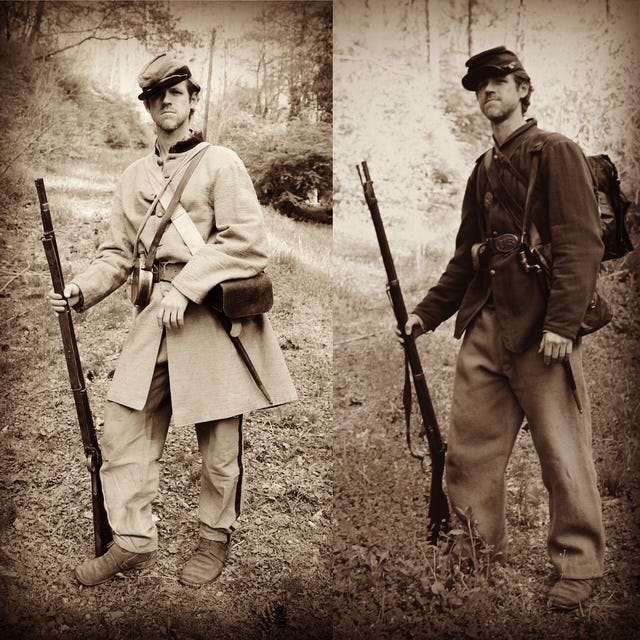
Bitterly divided over the slavery question, one Prentiss served for the Union, the other for the Confederacy. When they were both mortally wounded at the Siege of Petersburg, a colonel of the Sixth Maryland made sure they were brought together to be reunited. If they were carrying tintypes, they would have matched.
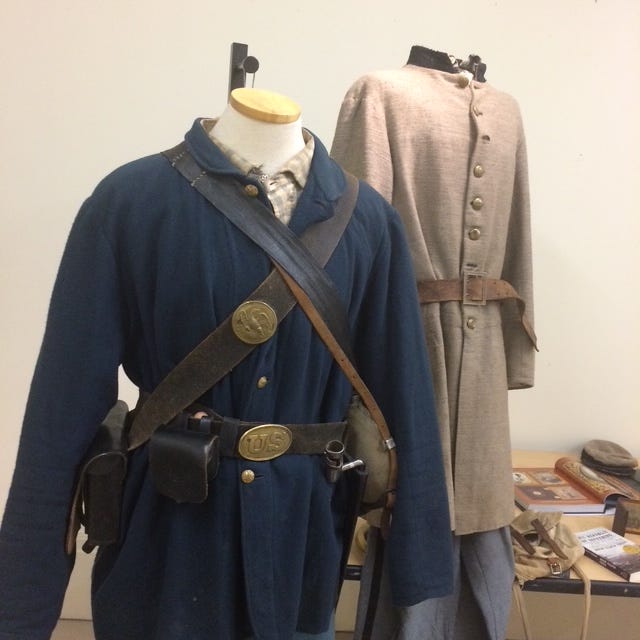
My residency at the Gibbes was in June of 2018. With hundreds of visitors, I discussed the anxiety of a divided America and my intent behind the diptych. I felt my job was to stay close to Homer. America was divided, yes, but surely things would improve?
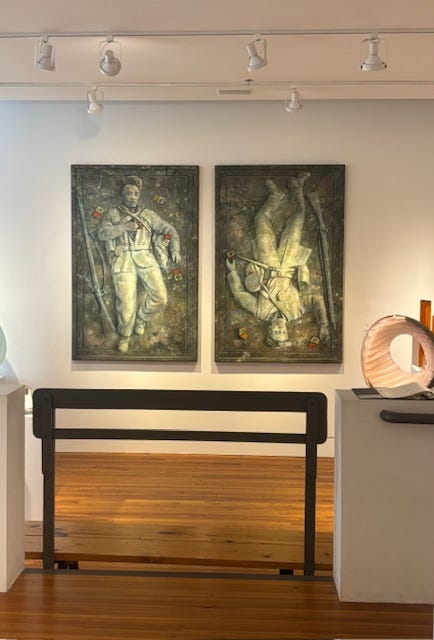
The diptych was displayed for the first time earlier this month in Asheville, North Carolina, and in the same week that an assassination in Utah had public figures across America calling for civil war.
On February 15th, 1861 Mary Boykin Chesnut, the wife of a South Carolina senator, wrote in her famous diary:
South Carolina had been rampant for years. She was the torment of herself and everybody else. Nobody could live in this state unless he were a fire-eater. Come what would, I wanted them to fight and stop talking. South Carolinians had exasperated and heated themselves into a fever that only blood-letting could ever cure. It was the inevitable remedy.
Julyan- this is incredible, thank you! In my profession as a therapist, I see the similar call to be political. It's concerning, Im pretty sure my calling to this field was about bringing a non dual environment to the therapy room so individuals can experience their own humanity and this offering humanity to others?